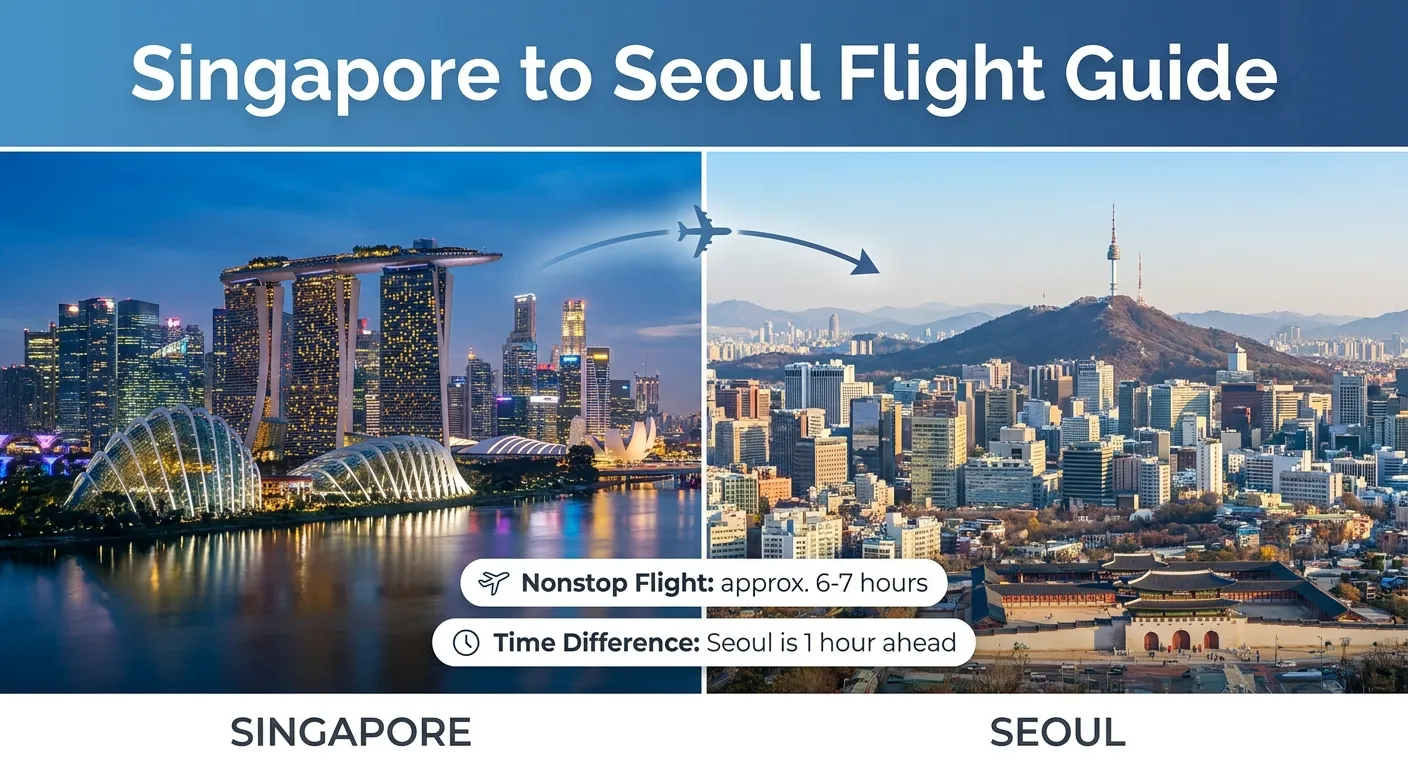
Singapore and Seoul sit about 4,650 km apart, and a nonstop flight between them takes a little over six hours. This Singapore to Seoul flight guide is for anyone planning the trip in late 2026 or early 2027. It covers the airlines on the route, flight times, the cheapest months, and the entry rules for Singaporeans.
You will also find the fastest ways from Incheon Airport into the city, with prices in Singapore dollars. We checked fares, schedules, and entry rules in October 2026, so please confirm the details again before you pay. Three big changes also land in December 2026, and we explain each one below.
Six airlines fly nonstop from Singapore to Seoul: Singapore Airlines, Korean Air, Asiana Airlines, Trinity Airways, Jeju Air, and Scoot. The flight takes about 6 hours 10 minutes to 6 hours 50 minutes, and Seoul is one hour ahead of Singapore. Singaporeans can visit Korea without a visa for up to 90 days, and Kayak data shows February as the cheapest month.
Direct Flights from Singapore to Seoul in 2026
Singapore Airlines runs the most direct flights from Singapore to Seoul, with four departures every day. Next comes Korean Air with three flights a day, and four smaller airlines fill in the rest. In total, about 72 nonstop flights a week leave Changi Airport for Incheon International Airport (ICN).
The table below shows how often each airline flies the route, based on schedules updated on 5 October 2026:
| Airline | Type of Airline | Nonstop Flights per Week |
| Singapore Airlines | Full-service | 28 |
| Korean Air | Full-service | 21 |
| Asiana Airlines | Full-service | 7 |
| Trinity Airways | Low-cost | 7 |
| Jeju Air | Low-cost | About 5 |
| Scoot | Low-cost | About 3 |
Trinity Airways is the new name for T’way Air, a Korean budget airline. It switched to the new brand on 10 September 2026, but it still uses the flight code TW. Some booking sites may still show the old name for the same 11 pm flight.
One-stop tickets can cost less in busy months, though they take much longer. Vietnam Airlines, for example, sells trips through Hanoi or Ho Chi Minh City. These often run nine hours or more, so they suit travellers with time to spare.
Asiana will also disappear as a separate brand very soon. Korean Air plans to absorb it fully on 17 December 2026, so later Asiana flights will carry Korean Air flight numbers. If you hold Asiana Club miles, plan to use them before mid-December.
Every Singapore to Seoul flight guide should also point out the terminals at both ends. At Changi, Scoot uses Terminal 1, Singapore Airlines uses Terminal 2, and Korean Air and Jeju Air leave from Terminal 4. In Seoul, Korean Air and Asiana land at Incheon Terminal 2, while the other four airlines use Terminal 1.
How to Plan Your Trip with This Singapore to Seoul Flight Guide
A smooth trip comes down to five choices: flight time, booking date, entry papers, airport transfer, and airline. The sections below cover each one in turn, with real prices and times. Use this Singapore to Seoul flight guide as a simple plan, and start with the clock.
Singapore to Seoul Flight Time and Time Difference
The nonstop Singapore to Seoul flight time is about 6 hours 10 minutes to 6 hours 50 minutes. Jeju Air flies a smaller Boeing 737 MAX, so its trip usually sits at the slower end of that range. The flight back to Singapore takes a little longer, at around 6 hours 40 minutes on average.
Seoul runs one hour ahead of Singapore all year, since Korea does not use daylight saving time. A Singapore Airlines flight that leaves Changi at 8:30 am lands in Seoul at about 3:50 pm local time. You lose only one hour on the clock, so jet lag is rarely a problem.
Most departures leave Changi either in the morning or between 10 pm and 3 am. The late flights reach Seoul between about 6 am and 10 am, which gives you a full first day in the city. Light sleepers may prefer a morning flight, which lands in time for an early dinner. On a flight this long, pick a window seat to sleep or an aisle seat if you get up often.
When to Book Cheap Flights from Singapore to Seoul
February is usually the cheapest month to fly, with return fares averaging about S$496 on Kayak. Cheapflights points to July instead, so treat both months as a rough guide. On its own site, Korean Air listed economy return fares from about S$558 for late 2026.
Budget airlines can cut that price a lot on sale dates. Google Flights recently showed Jeju Air one-way fares from about S$176, the lowest on the route. These fares rarely include a checked bag, so add a suitcase before you compare totals.
Set a fare alert on two or three booking sites, then watch prices for a few weeks. School holidays in June and December push fares up, so book early for those weeks. Booking with the airline itself also makes date changes easier if your plans move.
The time of year matters as much as the fare you pay. Cherry blossoms usually peak in early April, and autumn leaves turn red from late October to mid-November. Both periods sell out fast, so book at least two months ahead if you want to see them. Winter days in January often stay below freezing, while late June and July bring the rainy season.
Korea Entry Rules for Singaporeans
Singapore citizens can visit South Korea without a visa for up to 90 days. The Korean Embassy in Singapore confirms that Singaporeans do not need a K-ETA until 31 December 2026. You still need the free e-Arrival Card, which takes about ten minutes to fill in:
- Open the official e-Arrival Card website within 72 hours before you land.
- Enter your passport details, flight number, and Seoul hotel address.
- Answer the short questions about your trip and submit the form.
- Save the confirmation on your phone, in case an officer asks to see it.
This part of any Singapore to Seoul flight guide changes the fastest, so check it again before you fly. The K-ETA waiver ends on 31 December 2026 unless Korea extends it once more. From 1 January 2027, you may need a K-ETA before boarding, which costs about S$9.
Apply only on the official K-ETA website, because fake agents charge far more for the same form. Singapore citizens aged 17 and above can also use the Smart Entry Service gates at Incheon, according to Mainly Miles. If you live in Singapore on another passport, check the rules for your own country.
Getting from Incheon Airport to Seoul
The AREX Express train is the fastest way into the city, and it never gets stuck in traffic. It reaches Seoul Station in 43 minutes from Terminal 1 and 51 minutes from Terminal 2. A one-way adult ticket costs KRW 13,000 at the station, or about S$12.
The AREX All-Stop train is cheaper and leaves every few minutes from both terminals. It takes about an hour to Seoul Station and stops at Hongik University Station, which suits anyone staying in Hongdae. You can pay with a T-money card, sold at the convenience stores in the arrivals hall.
Late arrivals need a backup plan for the ride into town. The first express train leaves Terminal 2 at about 5:15 am, and the last one leaves before 11 pm. After that, night buses and taxis take over.
Airport buses are a good choice if your hotel is far from a train line. They run to most big areas of Seoul, such as Gangnam, Myeongdong, and Jamsil. The ride takes longer in traffic, but the bus drops you much closer to your door. A taxi to central Seoul adds a road toll on top of the meter, so the fare costs more than you might expect.
Full-Service or Budget: Which Airline to Choose
All six airlines fly the same six-hour route, but the trip feels quite different on each one. Here is how they compare on the things most travellers care about:
- Singapore Airlines has the most daily flights and earns KrisFlyer miles.
- Korean Air flies three times a day and suits SkyTeam members.
- Asiana suits Star Alliance members until it joins Korean Air in December.
- Trinity Airways flies an Airbus A330, which feels roomier than most budget jets.
- Jeju Air often has the lowest base fares but flies a narrower Boeing 737.
- Scoot flies a Boeing 787, though only two or three times a week.
For a six-hour overnight flight, a meal and a checked bag are worth paying for. Full-service fares include both, so the price gap often shrinks once you add extras to a budget ticket.
Singapore to Seoul Flight Guide Checklist Before You Fly
Run through this list two days before you leave for Changi. A missing form at the check-in counter causes far more stress than a heavy bag does:
- Make sure your passport is valid for at least six months from your travel date.
- Submit your e-Arrival Card within 72 hours before you land.
- Confirm your Changi terminal, since airlines on this route use all four.
- Pack a plug adapter, because Korea uses two-pin Type C and Type F sockets.
- Download Naver Map or KakaoMap, as Google Maps gives limited directions in Korea.
- Buy a Korean eSIM or turn on data roaming before you board.
- Bring a warm jacket from November to March, when Seoul often drops below 0°C.
- Change a small amount of cash into Korean won for street food stalls.
At about KRW 1,080 per Singapore dollar in September 2026, S$100 buys roughly KRW 108,000. Most shops, cafes, and taxis in Seoul take cards, so you only need a little cash.
Frequently Asked Questions
Which airline is best for a Singapore to Seoul flight?
Our pick in this Singapore to Seoul flight guide is Singapore Airlines, because it runs four daily flights and includes a meal in every fare. Our second choice is Korean Air, which works well for SkyTeam members. Trinity Airways is the best budget choice, since its larger A330 makes an overnight flight easier.
How far is Seoul from Singapore by plane?
The flight distance between Singapore and Seoul is about 4,650 km, or roughly 2,890 miles. That makes it a medium-haul trip, much longer than a flight to Hong Kong or Bangkok. Most nonstop flights take just over six hours, so an overnight departure gets you to Seoul by breakfast.
Can I fly from Singapore to Gimpo Airport instead of Incheon?
No nonstop flights currently run from Changi to Gimpo Airport, so every direct flight lands at Incheon. Some one-stop tickets do reach Gimpo, which sits closer to central Seoul. These trips usually take much longer, so they rarely make sense unless the fare is far lower.
Do Singapore residents on other passports need a Korean visa?
It depends on your passport, not on where you live. Australians and many Europeans can enter Korea without a visa, while Malaysians may need a K-ETA before they fly. Indian citizens usually need a full visa in advance. Check the Korean Embassy website with your exact passport before you book anything.
What changes should travellers watch for after October 2026?
Three changes arrive before the new year. Asiana becomes part of Korean Air on 17 December, and the K-ETA waiver for Singaporeans ends on 31 December unless extended. T’way Air also now flies as Trinity Airways. We will update this Singapore to Seoul flight guide as each change takes effect.
Conclusion
For most people, the best Singapore to Seoul flight is an overnight nonstop on Singapore Airlines or Korean Air. You land around breakfast, ride the AREX Express to Seoul Station in 43 minutes, and lose only one hour to the time difference. Budget travellers should price Trinity Airways or Jeju Air with a checked bag added.
Use this Singapore to Seoul flight guide to sort out three things before you pay: your e-Arrival Card, your Changi terminal, and a fare alert. If your dates can move, watch February fares on Kayak. Trips in 2027 may also need a K-ETA, so bookmark this Singapore to Seoul flight guide and check back before you book.